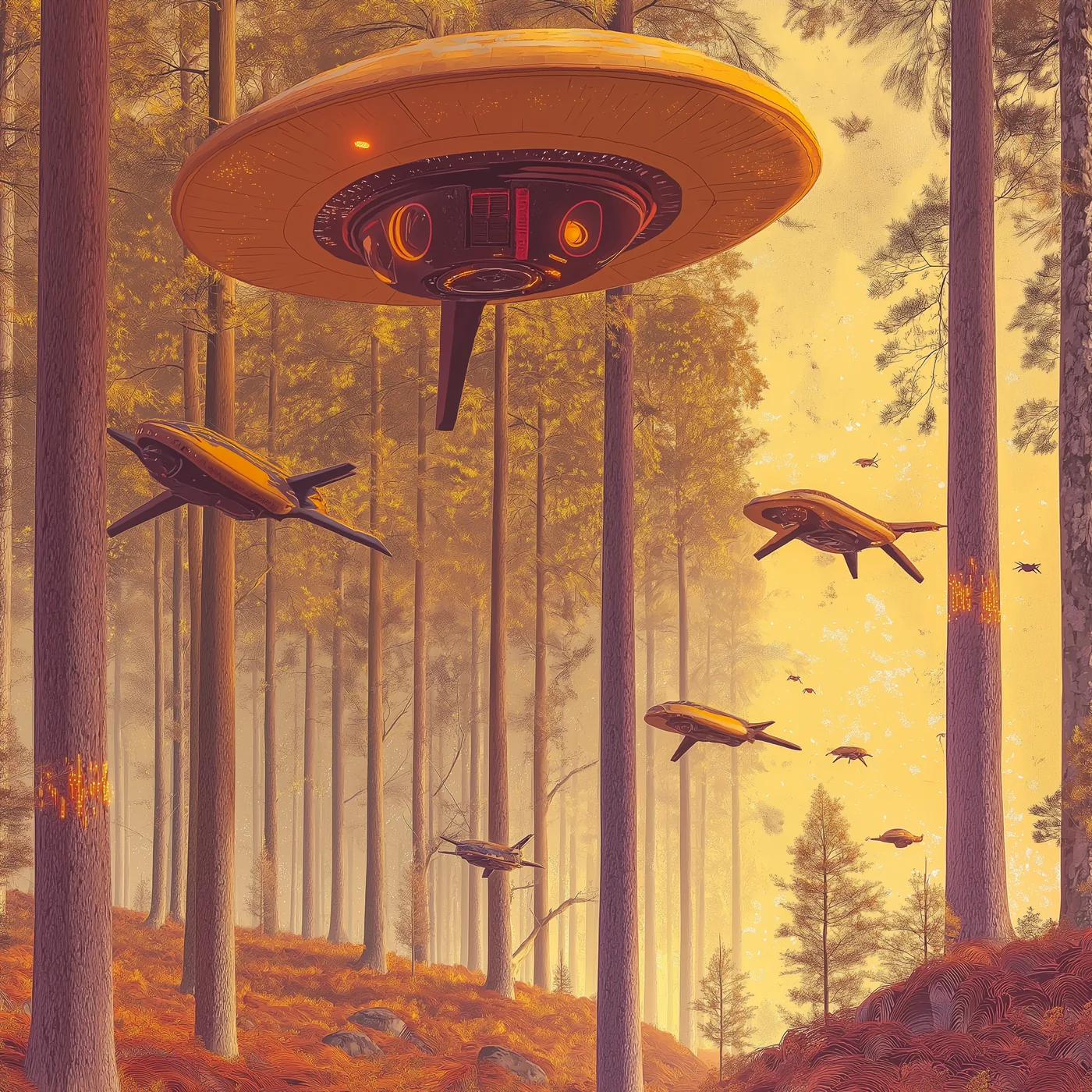
Zhang’s morning commute took him beneath a lattice of mirrored domes and whirring surveillance arrays. Along the service road, an echelon of drones swept through the redwood canopy, their sensors scanning for fungal anomalies. Whenever a spore cluster edged beyond safe thresholds, a caretaker drone would detach, inject a localized biocide, then rejoin the formation without a sound. Protocol called for constant redundancy: overlapping flight paths, live telemetry feeds, emergency neural alerts to any custodian in the field.
He’d grown indifferent to it all. Years of watching drones tend the forest like clockwork had dulled any sense of wonder. Today, his mind flew elsewhere: the upcoming council meeting, the barcode-stamped dossier waiting on a steel table, and dread began to coil in his gut.
The council room was windowless, painted in a clinical shade of off-white, and smelled faintly of disinfectant. A single fluorescent bulb flickered overhead. Zhang sat awkwardly at the edge of the steel table, flanked by three Lorax administrators in dull gray jackets and two Fredwood envoys in faded green overalls. Everyone looked more exhausted than invested.
Without ceremony, a woman from the Lorax side slid a thin dossier toward Zhang. It bore no official markings besides a barcode and today’s date.
“Conditional Dome Diagnostics – Site 4B,” she stated. “You will need to authorize either Lorax technicians or Fredwood biotechs to oversee repairs in the Muir woods. You have until end-of-day.”
“Is there a preference?” Zhang asked cautiously.
“No preference,” a Fredwood envoy said, indifferent, his voice clipped. “Only consequences.”
With that, the council stood and dispersed in silence, save for their footsteps echoing sharply on polished concrete.
An hour later, Zhang ran steadily along the narrow forest trail, his breath forming small clouds in the cool air. Around him, the woods were eerily quiet, the ancient redwoods towering and indifferent. His neural link streamed the day’s headlines through a bone-conduction headphone:
“Local market indices continue their decline amid Muir Woods uncertainty. Analysts warn awarding a contract to Fredwood technicians could trigger further economic instability in a region starved for revenue”
Zhang slowed his pace, the familiar ache of uncertainty heavy in his chest. He glanced up, noting the twisted fungus clusters clinging ominously to the redwood trunks.
Emerging from the misted canopy, a larger drone drifted into view. Cultivar Helm, the field’s chief caretaker. Twice the size of its kin that Zhang saw on his morning stroll. Its domed sensor array swept meticulously over the fungal growth, marking hotspots on its integrated holo-map. Its telescopic arms extended to touch a cluster, gently probing the mycelial network. Within seconds, its core processors ran a diagnostic suite: spore density, localized soil pH, and humidity gradients.
With its diagnostics complete, Cultivar Helm retracted its arms, broadcast a containment protocol, and signaled the release of a squadron of smaller caretaker drones. They fanned out in precise vectors, armed and calibrated to deploy targeted fungal inhibitors based on the Cultivar Helm’s readings.
Zhang dispassionately monitored the unfolding game of whack-a-mole. The presence of the fungal networks had long stopped being unsettling for Zhang. Whether he liked it or not, the fungus clusters were now part of this ecosystem.
Talking heads in his neural link continued to mutter:
“—Meanwhile, security forces remain vigilant after recent threats from the fungal rights extremist organization, the Mycelium Dawn Collective, cautioning that Lorax-aligned decisions to completely exterminate the fungus from the woods could provoke retaliatory actions—”
Zhang’s pace faltered, his pulse quickening at the mention of the Mycelium Dawn Collective. He stopped, placing his hands on his knees, breathing heavily. Two paths stretched before him—clear and stark. Align with Lorax: the market calms, tourists return to the forest but Fredwood tensions escalate, risking violent reactions from Mycelium Dawn. Choose Fredwood and manage the fungus problem instead of exterminating it: economic turmoil deepens in the region, unsettling an already anxious population.
He straightened slowly, resuming his run, knowing he must soon decide. No matter which path, the consequences were going to be severe.
Hours later, Zhang stood in the dim glow of the control room. Screens filled with drone telemetry as Lorax technicians executed his orders. Swarms of drones methodically eradicated the fungus clusters, leaving scorched bark in their wake.
At that moment, Zhang felt he had made the most humanistic choice available. He was an economist by training, sworn, in a sense, to heed market signals as the purest measure of collective well‑being. His ancestors had consistently ignored economic realities, building quarantine walls and biotech domes that collapsed under their own idealism, only deepening the forest’s suffering. If he could give the market what it wanted, which was complete extermination of the fungus clusters, then perhaps that would bide him some time for a more ecologically reasonable solution.
New headlines began to stream in:
“Fredwood representatives condemn Dome sterilization, calling it ’short-sighted destruction of vital biodiversity.”
“..Mycelium Dawn Collective releases statement: ‘Zhang lineage continues cycle of ecological betrayal. Wei Zhang, Li Zhang, and now Zhang himself will be remembered for centuries of violence against the forest’..”
Two days later, Zhang was again running through the quiet trails, his neural link muted. He needed time away from the cacophony. The forest was unnervingly still. The trees held their breath.
Then, from the canopy above, a squadron of caretaker drones swooped in low, their propellers humming a menacing chorus in Zhang’s ear. He had never seen the drones fly so low and close to a human before. Before he could calibrate what was going on, he saw metal arms shoot out from the drones. They gripped his wrists like mechanical vines. Before he could wrench free, the drones lifted him off the ground, carrying him upward through the redwood boughs.
Dangling midair, Zhang gasped as a fine mist sprayed from hidden nozzles on one of the drones. The mist burned with an acrid, earthy scent. Darkness crept in at the edges of his vision as the world tilted and faded, and then eventually went dark.
Zhang awoke bound in a cavern, bioluminescent fungi casting eerie shadows of figures on the walls. “Reverse your decision,” said a Mycelium Dawn member in a luminous bio mask. Zhang kept his words to himself and the last thing he remembered was a man approaching him with a syringe containing a blue liquid.
Through the haze, Zhang recognized the blue liquid. It was the psychotropic brew revered by the Mycelium Dawn Collective. This underground network worshipped the fungus not merely as an ecological marvel but as a gateway to transcendent revelations. They believed each hallucination was a communion, proof of the fungus’s divine will and a blueprint for a new, symbiotic world order.
Visions overwhelmed Zhang, vivid and horrifying. He saw his grandfather, Wei Zhang, coldly signing off on quarantines, creating lifeless wastelands littered with the skeletal remains of animals and trees petrified in adolescence. His father, Li Zhang, calmly observed forests twisted into horrific shapes, branches reaching desperately skyward, roots pulsating and gasping beneath corrupted atmospheres. Humans trapped in sterile domes screaming soundlessly behind glass walls.
The future branched out grotesquely. Gigantic redwoods, impossibly tall, whispered conspiracies among themselves in voices of rustling leaves and creaking branches, luring hypnotized crowds of emaciated humans who shuffled forward in endless procession, expressions of rapture and oblivion etched on their faces. Then the trees ignited spontaneously, columns of roaring flame consuming people and forest in an ecstatic, purifying blaze, flesh and bark fusing together as screams evaporated into the blazing infernal night.
Zhang screamed awake. He found himself in the middle of the woods. The first light of dawn broke through the canopy, while a shadow enveloped Zhang’s mind.
A week passed in a blur of insomnia and frayed nerves. At dawn on Monday, Zhang made his way to the Archive—the massive subterranean vault, which among other archives, housed the digital twin of Muir Woods—a comprehensive, multi-layered simulation built to preserve the forest’s genomic data, ecological interactions, and climatic context for future restoration efforts.
Designed in the wake of the Red Crisis, the twin combined LIDAR scans, drone-captured hyperspectral imagery, soil microbiome profiles, and historical climate records into a living model. Researchers and custodians used it to run predictive scenarios to test fungal integration strategies, anticipate fire behavior, and calibrate biome interventions. This ensured that every decision echoed through both digital and physical realms. There, amidst humming server banks and flickering holo-projectors, Zhang found the Integrator, Lián, bent over a translucent map of projected forest-growth models. Lián’s thin frame was draped in muted greys, his focus absolute.
“Master of balance,” Zhang began, voice hoarse. “I have seen the past and the future. I am lost.”
Lián didn’t look up immediately. He traced a vein of data along the twin’s simulated root network, then turned with calm eyes. He spoke softly, each word deliberate:
“Water does not seek to bury the mountain. It flows around in silence. Fire does not destroy the valley; it reshapes the ridge. To conquer the fungus is to invite its return, but to guide its growth is to become its steward. Those who solve too quickly create new shadows. Embrace the path of the root: gentle, deep, unseen.”
Zhang listened, the words entwining in his mind like creeping mycelium. He exhaled, feeling a strange peace settle in his chest.
Days later, still recovering, he met privately with Fredwood representatives. They calmly outlined their strategy: managing fungi like bears were managed in the ancient forests.
The Fredwood Protocol:
- Controlled fungal growth zones monitored by biotech sensors.
- Engineered insects to manage fungal proliferation naturally.
- Drone protocols adjusted periodically for symbiotic coexistence.
- Regular ecological impact assessments.
Desperate to halt the karmic spiral, Zhang authorized the new protocol, betraying Lorax.
Within weeks, Lorax administrators attempted a coup. Unexpectedly, Mycelium Dawn intervened, hacking security networks and publicly exposing Lorax plots to overthrow Zhang.
As night fell on a lonely day in September, Zhang stood alone on a ridge, a wildfire blazing fiercely along the horizon. Caught between ecological truth and uneasy alliances, he stared at the flames. His vehicle hummed softly behind him. He wondered whether to drive toward the fire, escaping the impossible choice, or remain bound to his family’s endless promises and debts.