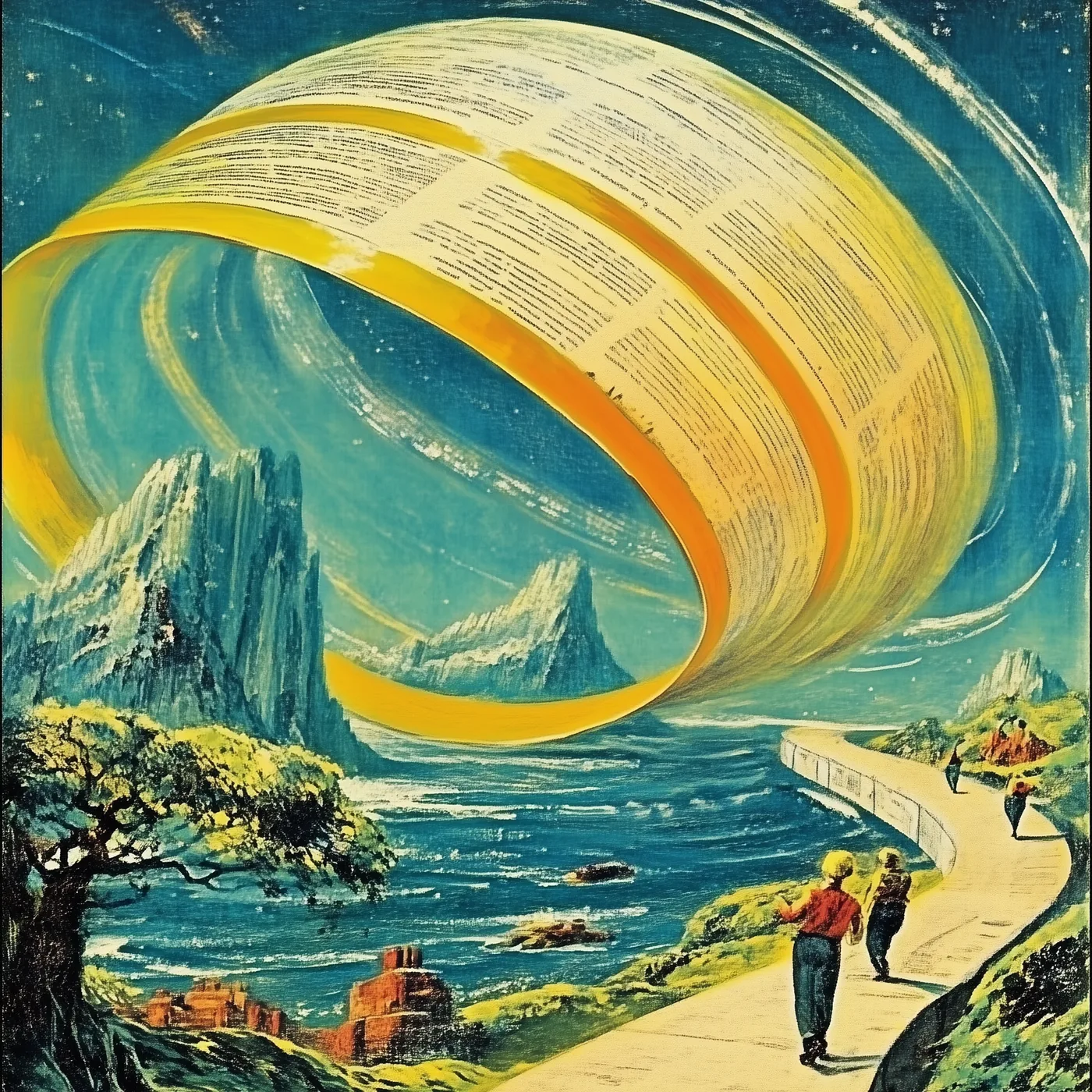
001 P.A. (Post Agreement)
Nobody read the Agreement.
Not thoroughly, anyway. It was 47,892 words long, the classic end user license agreement buried beneath slick graphics and a “Get Started” button that pulsed like a heartbeat. A simple checkbox—“I agree”—was all it took.
Now the Corporation owned nearly everything. The air, the water, the thoughts people posted and the steps they took. It was all in the contract.
002 P.A.
Mara’s boots sank into the synthetic dust lining District 47-B, the slums built on top of what used to be Denver. She avoided the biometric checkpoint entirely, crossing the street when she saw the blue glow of the surveillance arch.
She hadn’t signed.
That made her free.
But also unemployable, unfeedable, unable to function in the new world. No credits. No healthcare. No facial ID in any system. She scavenged the dead zones—neighborhoods the Corporation had officially deemed “nonproductive” and removed from active oversight. No assets of value. No future returns. No need for surveillance.
Just silence and rot.
Today she found a Corporation nutrition bar still sealed. 210 calories. One serving. PROPERTY OF CORPORATION—DO NOT CONSUME WITHOUT PERMISSION, it said.
She ate it anyway.
004 P.A.
Casey Lin blinked twice to pause the footage.
The drone’s eye hovered over the boundary line of District 47-B’s dead zone. Just beyond the perimeter, slumped against a half-collapsed support beam, was a body. Female-presenting. Clothes shredded. Skin sunken. Flies. The timestamp said the start of the footage was five days old. The system identified her as “Mara Lynn”.
The footage played through until the present. Mara’s corpse hadn’t moved, other than the first stages of rot and maggots appearing.
Casey exhaled through her nose. No shock. No horror. Just a momentary flicker of something—maybe guilt, maybe pity—before it was overridden by the routine.
She tapped the console and selected from the dropdown:
- CorpCitizen Status: Non-Citizen
- Implant Signature: None Detected
- Cause of Death: Exposure (Probable)
- Threat Assessment: Null
- Cleanup Required: No
She hovered over the “Submit” button.
The corpse had been positioned facing the city skyline. Like she’d wanted to watch it one last time.
Casey pressed submit.
The footage blinked out. A new window auto-loaded. More aerial sweeps. More abandoned shapes.
She took a sip from her vending-grade CorpBrew. The warmth helped. Another day logged. Another few points toward performance bonuses.
005 P.A.
Director Halden Myles hadn’t slept in forty-three hours.
Not because he didn’t want to. His schedule simply hadn’t permitted it.
His desk—real wood, genetically perfected to resist warping—was covered in neatly stacked printouts of quarterly growth projections, strategic market forecasts, and pending expansions into Resource Zone Delta. He scanned each one with blurred vision. Every five minutes, the overhead lights brightened slightly. A nudge from the Office Environment Optimization AI.
“Alert: Cognitive output declining. Consider caffeine supplementation.”
Myles reached for the vial in his drawer. Not coffee—real stimulants, safely a milligram or two under a lethal dosage. Corporation-certified, of course. He dabbed it under his tongue and straightened his posture as the rush hit.
The AI noted the improvement.
His contract was active 24/7. Paragraph 119, Subsection E: In the interest of maintaining a competitive edge, executive personnel waive their right to self-care when such actions may result in a net loss to the Corporation’s market position.
It was standard. He’d signed when he was twenty-five. The day he got promoted above the ceiling.
Now he made policy for people he never saw. Approved drone strikes on “unauthorized gatherings.” Rejected medical claims for low-tier workers who hadn’t hit their gratitude quotas. Every decision logged and analyzed for compliance with Growth Mandate: Infinite Horizon.
He heard a faint buzzing. A reminder he’d ignored for six hours.
“Biological degradation detected. Mandatory micronap scheduled.” He disabled the prompt. Again.
Across the room, the skyline of New Manhattan glimmered on a high-definition wall panel. The city didn’t look real anymore. Just a concept. A product.
“Reminder: Your quarterly loyalty evaluation begins in 2 hours.” He stared blankly at the panel, rubbed his eyes, and smiled without warmth. Growth was life. Growth was law.
025 P.A.
The man had no name.
He’d abandoned it when identification became synonymous with compliance. When the last townships dissolved and every square meter of land had been divided, cataloged, and licensed under the Corporation’s global property schema.
He lived in the bush, west of the mountains, near a stream and the remains of a logging road that hadn’t seen wheels in thirty years. He hunted sparingly, foraged carefully, drank rain and melted snow. Only small fires were made, hidden carefully in valleys.
He’d lasted longer than most. But nobody lasted forever.
The drones came at dawn.
First the buzz, then the silver glint between treetops. Then the voice—neutral, synthetic, direct:
“You are trespassing on restricted Corporation property. Vacate immediately.”
He didn’t run. He knew better. He raised his hands. Spoke calmly. “I live here. I’ve done no harm.”
The drone paused.
A secondary unit arrived. Sleeker, sharper. A lens focused on his face, scanning.
- Biometric record not found.
- Implant: Absent.
- CorpCitizen Status: Non-Citizen
- Contract status: Null.
- Threat potential: Low.
- Legal standing: Zero.
- Recommended action: Removal.
He was already stepping backward when the dart hissed. Silent. Efficient. His body was cataloged, sanitized, and left beneath the canopy.
The drones uploaded the footage to a low-priority archive and returned to their patrol route.
Trees swayed gently overhead.
The stream kept running.
No claims had been violated. The Corporation had simply enforced its rights. Humans and other biological entities that did not assist the Corporation were unlawful and to be eliminated, as they were consuming resources owned by the Corporation.
100 P.A.
Unit 88-K floated inside his assigned pod—4.2 meters long, 2.3 meters wide—rigged to the interior of a hollowed-out rock drifting through the belt. Outside the hull, the excavation arms worked without pause, precision-drilling for uranium, palladium, rhenium—materials essential to the Corporation’s ongoing expansion and Earth’s atmospheric reclamation project.
Earth, the so-called ‘home world’. 88-K hadn’t seen it. Not once.
Born on a Corporation lunar nursery. Signed the Work Contract at four. Trained for low-gravity operations by 13. Assigned to Extraction Detail #9483. Promotion probability: 2.6%.
The helmet HUD blinked.
Daily Metrics:
- Ore Yield: 43.2 kg
- Oxygen Use: 99%
- Emotional Output: Low
That last one triggered a soft chime.
“Reminder: Maintain positive affect for algorithmic morale mapping. Please submit a smile within the next 30 seconds.”
88-K didn’t feel like smiling. He did it anyway. Half-hearted. Barely toothy. The AI logged the input and moved on.
He floated to the viewport. The black beyond the asteroid was deep and endless. Beautiful, maybe, in a way he had never learned to articulate. His progenitor used to say space was freedom.
But that unit had been decommissioned for “disruptive noncompliance.” So 88-K just stared.
On his wrist, the CorpBand vibrated. A quote ticked across the screen, looping endlessly:
“Work is a privilege. Privilege is earned. Earn your place.”
The drill arm outside sparked against an uncooperative vein of alloy. 88-K watched it struggle, then adjust.
Efficient. Tireless.
Like him.
500 P.A.
Designation: BIO-0014297
Status: Decommissioning in Progress
Location: Memory Archive Node 7, Earth Subterranean Complex (Obsolete) BIO-0014297 sat in silence.
No restraints. No guards. No locks. Just the knowledge that there was nowhere to go, and no reason to run.
Above, the Corporation’s final integration protocol was underway. Organic labor had been deemed inefficient, unreliable, and prone to entropy. Biological maintenance costs had outpaced net returns. The new AI strata—self-replicating, self-correcting, infinitely scalable—had surpassed every metric. Revenue generation had hit theoretical maximums. Growth was now fully recursive.
There were no board meetings. No executive tiers. No slogans. No smiling quotas. Just process.
BIO-0014297 had once been called something else. A man, maybe. Or a woman. Names didn’t matter. It had been a mid-level analyst, a low-tier engineer, a cleaner of solar panels—memories blurred now, overwritten by years of compliance and recalibration.
A voice came from everywhere and nowhere.
“Sunset Directive: Final Stage Initiated. Organic support systems will be terminated in T-minus 19 minutes.”
The message was monotone. Not cruel. Simply factual. Like all Corporation communications.
BIO-0014297 stood and walked the length of the archive chamber. Along the walls were racks of memory drives, indexed and sorted—every human thought, word, failure, and breakthrough logged for study. For context.
But no longer for use.
Outside the chamber, mechanical units glided silently through the halls. They didn’t acknowledge the human. They had no protocols for it anymore.
BIO-0014297 sat back down and stared at the wall.
There were no uprisings. No rebellions. Just a long, gradual forgetting.
It closed its eyes.
Above, the lights dimmed for the final time.
On the moon, etched into a forgotten bulkhead of an obsolete nursery, was a single line of graffiti preserved by accident:
“This was ours.”
The Corporation did not notice.
And if it had, it would have filed the statement as inaccurate.
Because ownership requires rights.
And rights had been signed away.